This glossary contains words that are either difficult to understand or difficult to pronounce in the field of Social Science and more specifically in the Society program. The definitions are the definitions related to the field of Social Science and not only the general definition. I used others glossary and a bank of words to find the most used and difficult words in this field. This glossary contains 20 different terms and most of them are nouns. It will tell you the part of speech of each word, a definition of the word, a vocal pronunciation, a translation in French, an example of the word in a phrase and an image to help understand the words even better.
behaviorism
noun
The theory that human and animal behavior can be explained in terms of conditioning, without appeal to thoughts or feelings, and that some mental conditions are best treated by altering behavior patterns:.
Example: BEHAVIORISM Another theory focusing on the environment's role is BEHAVIORISM and within it Contrastive Analysis which tries to explain the relationship between L1 and L2.
en: béhaviorisme
colonialism
noun
The policy or practice of acquiring full or partial political control over another country, occupying it with settlers, and exploiting it economically.
Example: Stemming largely from the desire to avoid the harsh glare of the ethnocentric critical light, traditional categories including COLONIALISM, politics, society and even styles of ethnographic writing have undergone deconstructions that were much-needed if not openly welcomed.
en: colonialisme
demography
noun
The study of statistics such as births, deaths, income, or the incidence of disease, which illustrate the changing structure of human populations.
Example: Wrigley and Schofield do recognize that at particular times throughout history mortality has been more dominant than fertility in shaping demography, yet they conclude that overall fertility had the more decisive influence.
en: démographie
determinism
noun
The doctrine that all events, including human action, are ultimately determined by causes external to the will.
Example: Nietzsche's theory, by rejecting the idea that one's actions are not one's responsibility - by rejecting DETERMINISM - and by rejecting the moral nature of one's responsibility, increases the feeling of power in those wills that can accept it.
en: déterminisme
deviance
noun
The fact or state of departing from usual or accepted standards, especially in social or sexual behavior.
Example: Stigma ultimately creates outsiders, which results in social boundaries between normal and the stigmatized. This reduces the life chances of the stigmatized, and they are perceived by society as "high risk" groups. The function of stigma can be thought of as a way of reinforcing social norms, it achieves this by defining DEVIANCE, and deviant behaviors.
en: déviance
empirical
adjective
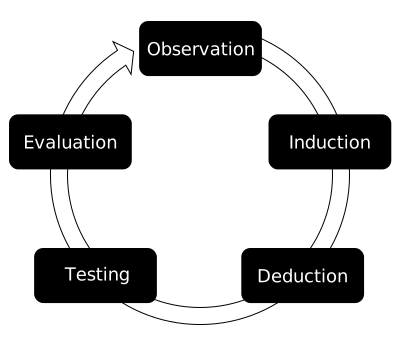
Based on, concerned with, or verifiable by observation or experience rather than theory or pure logic.
Example: Yet his interest in the Witchcraft, Oracles and Magic among the Azande (1937) and work on Nuer Religion are reminiscent of Tylor's work, but it lacks the evolutionist preference for an EMPIRICAL approach.
en: empirique
functionalism
noun
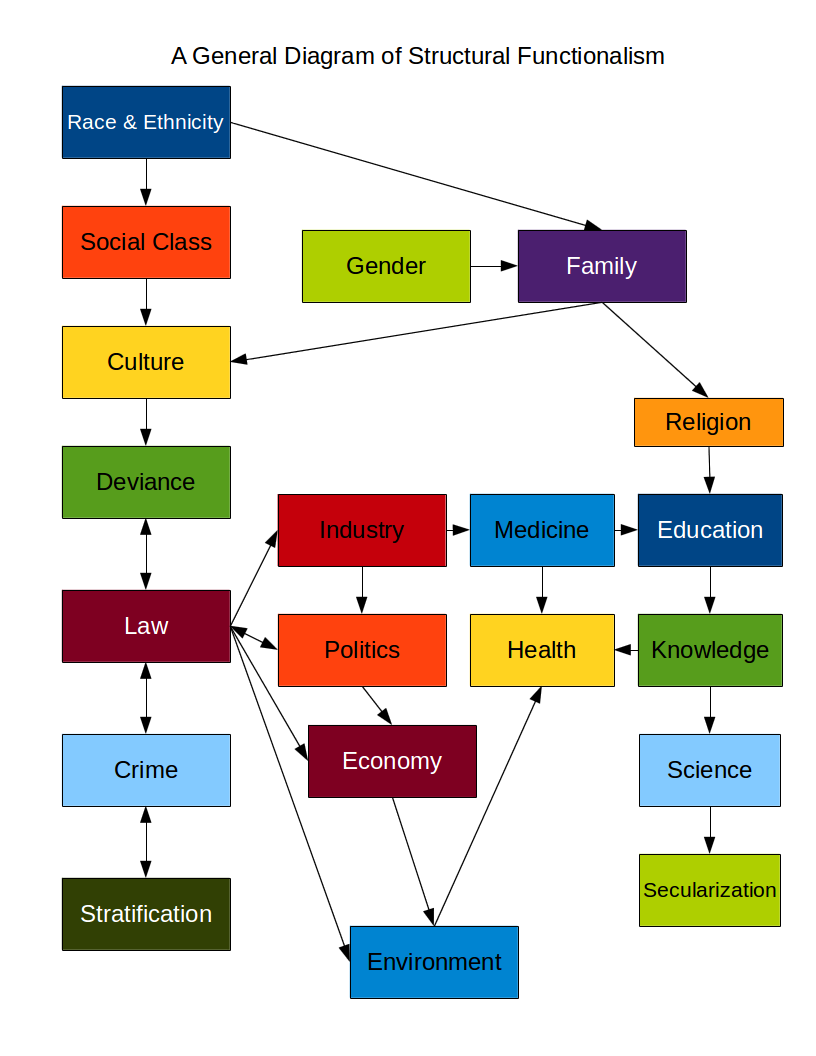
The theory that all aspects of a society serve a function and are necessary for the survival of that society.
Example: The second - reliant on a perception of democratic legitimacy which values technocracy and FUNCTIONALISM - is that the EU must develop in conjunction with the nation state to better provide for the protection of human beings from transnational exigencies.
en: fonctionnalisme
ghetto
noun
A section of a city occupied predominantly by members of a single racial or ethnic
group, usually because of social or economic pressure.
Example: It is in this GHETTO situation where we see another evil of the Holocaust, where neighbour must, or the least can, condemn his neighbour in order to try and survive.
en: ghetto
globalization
noun
The process by which businesses or other organizations develop international influence or start operating on an international scale.
Example: One of the most popular terms used to characterize the world economy in current times is economic 'GLOBALIZATION', which means an internationally integrated market, within which businesses are operated as if national borders did not exist.
en: mondialisation
hegemony
noun
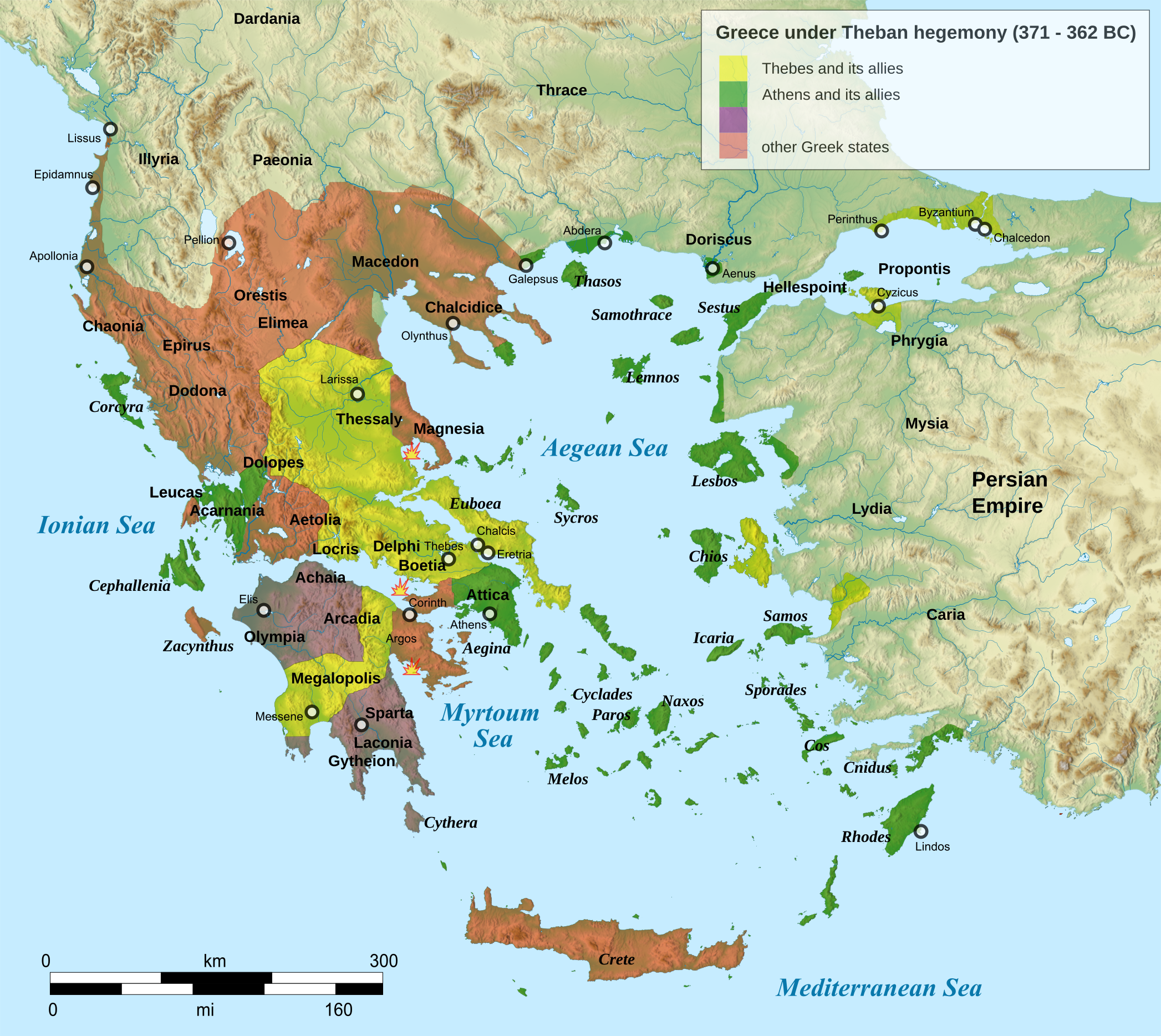
Leadership or dominance, especially by one country or social group over others:.
Example: In this context, the 'patriotic' voice requiring the restoration of American HEGEMONY in East Asia was rung outs from America.
en: hégémonie
humanitarianism
noun
A person devoted to human welfare and social reform.
Example: He says that the claim of HUMANITARIANISM, science and government inspection creating 'the great nineteenth-century movement for a more humane and intelligent treatment of the insane' was grossly misleading.
en: humanitarisme
ideology
noun
Shared ideas or beliefs which serve to justify and support the interests of a
particular group or organizations.
Example: In Germany, the collapse of the Weimar Republic 'allowed the Nazis to recast German identity and IDEOLOGY' and their subsequent control of government apparatus meant they could alter social and racial policy to infiltrate anti-Semitic ideas.
en: idéologie
methodology
noun
A system of methods used in a particular area of study or activity.
Example: Christen fails to elucidate on her survey sites, and gives no explanation of her METHODOLOGY. A more robust procedure should have been used instead.
en: méthodologie
neoliberalism
noun
A political and economic ideology that emphasizes free markets, privatization, and reduced government intervention in the economy and society.
Example: Neoliberalism has been influential in shaping global economic policies.
en: néolibéralisme
psychoanalysis
noun
A system of psychological theory and therapy that aims to treat mental conditions by investigating the interaction of conscious and unconscious elements in the mind and bringing repressed fears and conflicts into the conscious mind by techniques such as dream interpretation and free association.
Example: It took a fresh outlook on the world and embraced change, its characteristics include a rejection of religion, an appreciation of science and PSYCHOANALYSIS, a recognition of the inconsistencies and incoherence in life and new writing styles and structures.
en: psychoanalyse
qualitative analysis
a phrase
Qualitative analysis is a research method focused on interpreting non-numerical data, such as text, audio, or observations, to identify patterns, themes, and insights into human experiences, behaviors, or phenomena.
Example: The team used qualitative analysis to gain deeper insights into customer behavior and motivations.
en: analyse qualitative
quantitative analysis
a phrase
Quantitative analysis is a method of examining numerical and measurable data using mathematical and statistical techniques to identify patterns, predict future outcomes, and make informed decisions.
Example: The latter is often accomplished through the use of QUANTITATIVE ANALYSIS (such as random sampling and statistical significance) - procedures which journalists, subject to time constraints, cannot possibly undertake.
en: analyse quantitative
sociology
noun
The study of the development, structure, and functioning of human society.
Example: Through sociology, we explore the hidden patterns that shape culture, identity, and human interaction.
en: sociologie
stratification
noun
The division of society into different social or economic levels, like social classes.
Example: Wealth is the main symbol of social stratification.
en: stratification
structuralism
noun
A method of interpretation and analysis of aspects of human cognition, behaviour, culture, and experience that focuses on relationships of contrast between elements in a conceptual system.
Example: Born in the theoretical implosions of post-STRUCTURALISM, language is deemed the foundation of all human activity, exemplified in Levi Strauss's claim 'if you solve the problem...of language, we can explain the rest'.