My name is Michael, and I am a Nursing student at Cégep du Vieux-Montréal. I am in my fourth semester.
My glossary can be for everyone, especially for the people who are interested in nursing or nursing students.
I wrote plenty of materials or help/information that you should provide to a patient or a nurse.
If you don't know what happen or what do a patient have, this glossary can help you find it.
In this glossary, there are 15 terms. These are the ones that I see a lot in my internships and what you would see in a daily life of a nurse.
I chose the words in the book Actively Engaged Online by Nicholas Walker (the book that our teacher told us to buy).
I selected the terms and used the definitions at Prehospital Emergency Care Glossary.
I would like to know the term that you prefer.
catheter
Noun
a catheter is a medical device consisting of a tube of varying width and flexibility, and made of different materials depending on the model or the uses for which they are intended. The catheter is intended to be inserted into the lumen of a body cavity or blood vessel and allow the drainage of liquid or infusion, or access to other medical devices.
Example: The nurse carefully inserted the urinary catheter to facilitate bladder drainage after the patient's surgery.
en: cathéter
disinfect
Verb
clean (something) with a disinfectant in order to destroy bacteria.
Example: Before applying a sterile dressing, the nurse will disinfect the wound site to prevent infection.
en: désinfecter
glove
Noun
a covering for the hand worn for protection against cold or dirt and typically having seperate parts for each finger and the thumb.
Example: Infection control protocols require that healthcare professionals wear gloves when handling contaminated equipment.
en: gant
glucometer
Noun
a small, portable machine that's used to measure how much glucose (a type of sugar) is in the blood.
Example: Before administering insulin, the nurse will use a glucometer to check the patient's blood sugar level.
en: glucomètre
infection
Noun
the process of infecting or the state of being infected.
Example: Nurses must be vigilant in monitoring for signs of infection such as fever, redness, and swelling.
en: infection
injection
Noun
injection or injected may refer to: injection (medecine), insertion of liquid into the body with a syringe.
Example: The nurse prepared the patient for an intramuscular injection of the prescribed antibiotic.
en: injection
intervention
Noun
the act or fact of intervening.
Example: The nurse's primary intervention for this patient's pain was administering the prescribed analgesic and monitoring for effectiveness.
en: intervention
oxygen mask
Noun
a device that provides a method to transfer breathing oxygen gas from a storage tank to the lungs. It may cover the nose and mouth or the entire face.
Example: The nurse gently placed the oxygen mask over the patient's face to ensure proper oxygen flow.
en: masque à oxygène
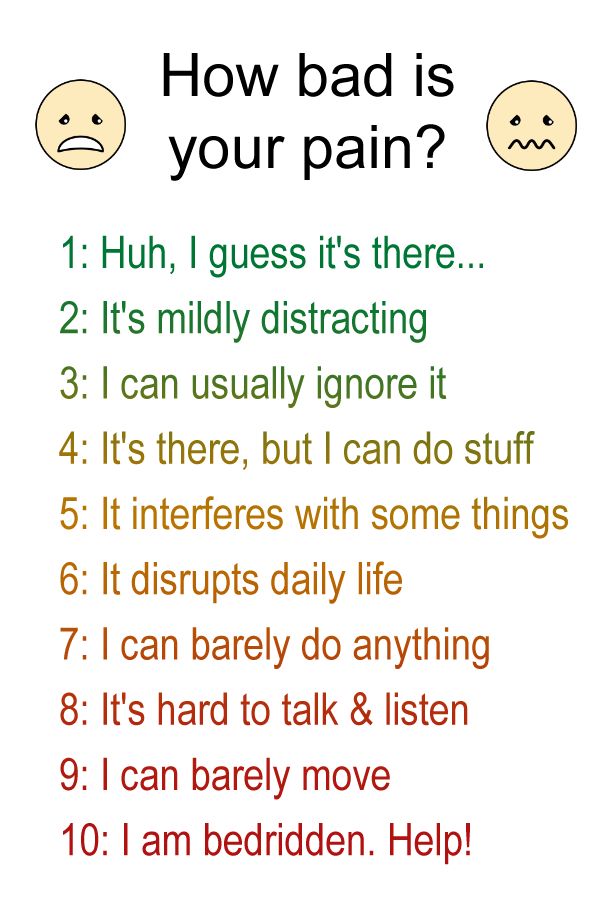
pain scale
Noun
a scale measures a patient's pain intensity or other features.
Example: The patient reports a pain level of 7/10 on the numeric rating scale, which is a moderate increase from their previous score of 5/10.
en: échelle de douleur
patient
Noun
a person receiving or registered to receive medical treatment.
Example: The nurse explained the procedure to the patient before starting it.
en: patient/patiente
pills
Noun
a small globular or rounded mass of medicinal substance, usually covered with a hard coating, that is to be swallowed whole.
Example: The patient needs to take three pills every four hours for pain relief.
en: pilules
report
Verb
give a spoken or written account of something that one has observed, heard, done, or investigated.
Example: During the handover, the nurse verbally reported the patient's status to the next shift, emphasizing specific needs.
en: rapport
stethoscope
Noun
an instrument used to detect and study sounds produced in the body.
Example: The nurse listened to the patient's heart with a stethoscope, noting a rapid but regular rhythm.
en: stéthoscope
treatment
Noun
management in the application of medicines, surgery, etc.
Example: The nurse administered the prescribed pain medication as part of the patient's treatment plan.
en: traitement
vital signs
Noun
they are measures of various physiological statistics in order to assess the most basic body functions.
Example: After assessing the patient, the nurse will signal the vitals, including respirations and pulse, to ensure they are within normal parameters.