My name is Catherine, and I have been in Biology for 2 years. My glossary is for other Biology students that want to review quickly on the go.
A huge part of studying biology is memorizing so frequent daily reviews is very important to ace exams. However, you may not always have your class notes with you so a portable lexicon is the best solution.
This glossary has 16 high school level terms from my own precollegial biology classes.
Small daily reviews is better for actually remembering what you need to memorize and for your stress levels. Keep calm and do your best on those biology exams.
antibody
noun
Antibodies are produced by B-cells to counteract antigens. They combine with substances which the body recognizes as foreign substances in the blood to neutralize it.
Example: Not any antibody can counteract any antigen.
en: anticorps
apoptosis
noun
The death of cells which occurs as a normal and controlled part of an organism's development.
Example: When a cell doesn't do apoptosis, it becomes a cancer cell.
en: apoptose
autotrophic
adjective
A cell capable of reproducing its own organic matter from mineral matter.
Example: Plants can do photosynthesis because they have autotrophic cells.
en: cellule autotrophe
B-cell(/B lymphocyte)
noun
B cells are a type of white blood cell and a part of the adaptive immune system.
Example: B cells make specific antibodies when the body identifies the foreign substance.
en: lymphocite B
cell
noun
Structural unit of living beings containing a cytoplasm, and being enclosed by a plasma membrane.
Example: We can find DNA (deoxyribonucleic acid) in the cell.
en: cellule
eukaryote
noun
An organism whose cells contain organelles.
Example: Animals, plants and fungi are all examples of eukaryotes.
en: eucaryote
gamete
noun
A reproductive cell (sperm or egg).
Example: Chicken eggs are gametes.
en: gamète
gonad
noun
An organ that produces gametes (testes or ovaries).
Example: Testes are male gonads.
en: gonade
heterotrophic
adjective
A cell capable of reproducing mineral matter from consumed organic matter.
Example: Fungi and animals have heterotrophic cells.
en: cellule hétérotrophe
host
noun
An organism within which another organism lives.
Example: The patient became the host for the antigens.
en: hôte
immune system
noun
Example: When a foreign substance enters the body, the immune system activates.
en: système immunitaire
organelle
noun
An intracellular structure delimited by one or more membranes.
Example: The nucleus is an organelle.
en: organite
pathogen
noun
A factor responsible for a disease.
Example: Viruses, bacteria and fungi are most of the pathogens.
en: agent pathogène
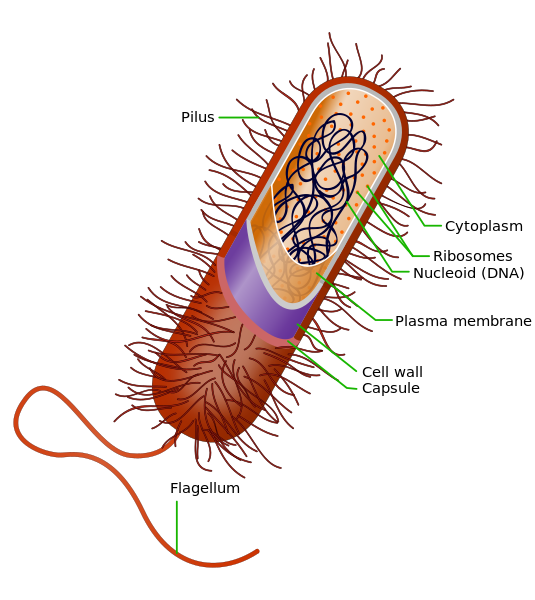
prokaryote
noun
An organism whose cells do not contain organelles (bacteria, red blood cells).
Example: Bacteria and red blood cells are prokaryotes.
en: procaryote
T-cell(/T lymphocyte)
noun
T cells are a type of white blood cell and a part of the adaptive immune system.
Example: T cells causes antigen to do apoptosis.
en: lymphocite T
tissue
noun
A group of specialized cells performing the same function.
Example: The stress caused a tear in the tissue of the patient.