This glossary is intended for people who are going to study statistics. Knowing several words related to this profession can be very helpful for people who are new to this field.
analysis
noun
In statistics, an analysis is taking a lot of data and examining it until you come to conclusions.
Example: ANALYSIS of purely linguistic variation is, however, an essential part of a study of language change, because language change is manifested as change in systems; therefore, in this chapter, I am mainly concerned with the principles of observing and analysing language variation in the community.
en: une analyse
average
noun
A number expressing the central or typical value in a data set. This is calculated by dividing the sum of the values in the set by their number.
Example: For those aged 65 - 74 hospital discharge rates increased by 35.8 per cent between 1971 and 1985 - an annual AVERAGE increase of 2.2 per cent. For those aged 75 + the increase in discharges was 46 per cent over the same period (AVERAGE annual increase of 2.7 per cent) (Bosanquet and Gray 1979).
en: une moyenne
calculation
noun
In mathematics, a calculation is an operation or a set of operations performed on quantities.
Example: To overcome such problems comparisons are usually made via the CALCULATION of standardized mortality ratios (SMRs).
en: calcul
calculator
noun
Something used for making mathematical calculations, in particular a small electronic device with a keyboard and a visual display.
Example: The easiest way to find the log of a number is on a CALCULATOR: enter the number and press the LOG button. If you haven't yet bought a CALCULATOR, you will have to look it up in either the old - fashioned log tables used for arithmetic calculations or in simplified "break tables" of logarithms (see Tukey 1977).
en: calculatrice
Character
noun
The character is the quantity on which the statistics relate, there are 2 types of characters. Qualitative (city of birth, work laboratory, ...) or quantitative (size, number of publications, ...).
Example: The number of data is a quantitative character.
en: caractère
Data
noun
Facts and statistics collected together for reference or analysis.
Example: For example, reflecting the needs of many TEI users to treat texts both as documents and as input to DATAbases, a sub - class of phrase called "DATA" is defined to include "DATA - like" features such as names of persons, places or organizations, numbers and dates, abbreviations and measures.
en: donnée
Data table
noun
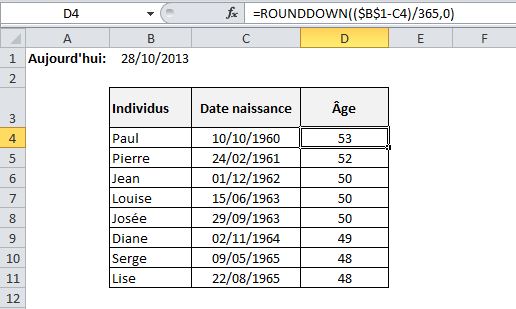
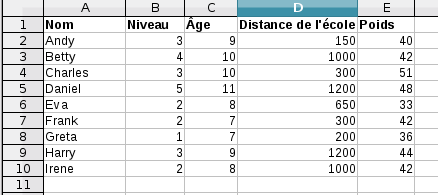
The data table is a way of collecting data in a table that can be drawn by hand or by computer. In its simplest form, it consists of a series of intersecting columns and rows in cells, plus a header row in which the column names are given, to make the data in the table understandable. for the end user.
Example: The photopeaks were matched up with the expected energies of sources given in a DATA TABLE and through a process of elimination the unknown sources were identified. 2.4.b Emission Spectroscopy: Results Figures 7 and 8 show the spectra for the two unknowns.
en: table de données
database
noun
A database is a set of structured information accessible by means of software.
Example: So to research my title I chose to use the search DATABASE International Bibliography of the Social Sciences (IBSS), I choose this DATABASE as it was simple and straight forward to use.
en: base de données
error
noun
In statistics, it means the condition of being wrong in its result or its calculation.
Example: I made a mistake adding 2 + 2. My result was 5 but the true answer is 4.
en: erreur
Estimation
noun
An approximate calculation or judgment of the value, number, quantity, or extent of something.
Example: As a result, any error - handling and ESTIMATION procedures should be sufficiently general as to be able to incorporate any new error model that may emerge at a later date.
en: estimation
Frequency
noun
In statistic, it means the number of times a value appears in a dataset. It can also be the number of events or items.
Example: However, the test is not conclusive, as "Many statisticians recommend a certain minimum expected FREQUENCY (fe) per cell.
en: fréquence
graphic
noun
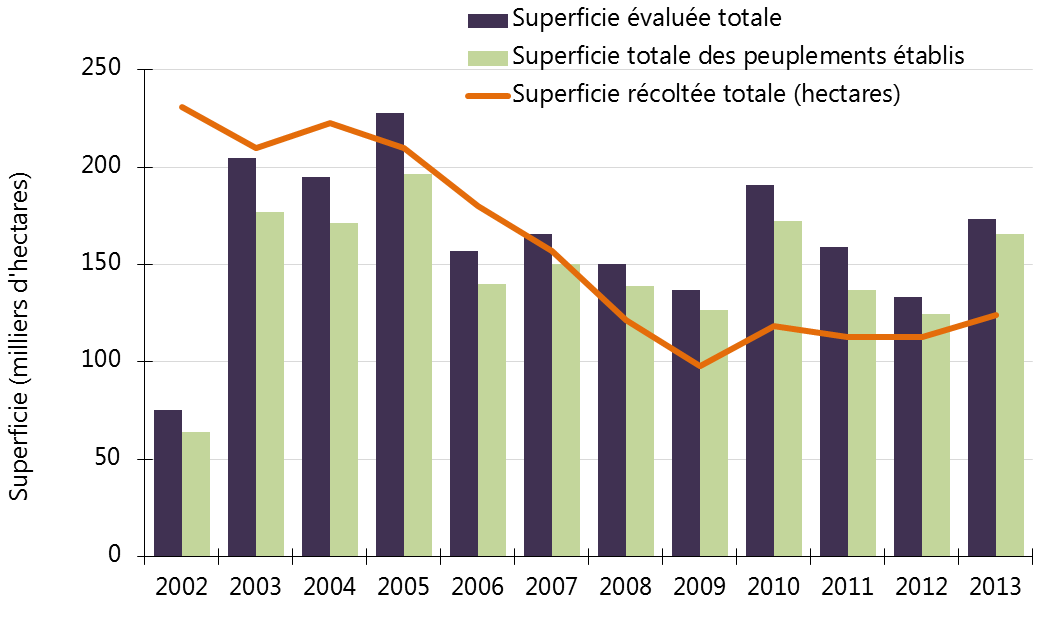
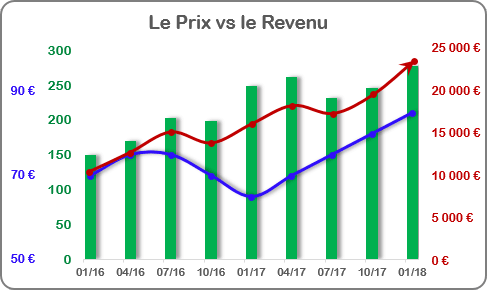
It is a pictorial way of representing a set of data.
Example: Particularly, the use of a GRAPHIC scale, which reduces that part of the bias in scaling resulting from the use of numbers; the statistical treatment of the data; the separation of panelists during evaluation; and the GRAPHIC approach to presentation of data are all the beneficial points of this methods.
en: graphique
median
noun
The median of a statistical series is the number that divides this statistical series into two parts of the same size, the values of the character being arranged in ascending order.
Example: From the 1930s to about 1970 the MEDIAN interval from marriage to first birth remained 20 months.
en: Médiane
outlier
noun
It is a value which is not necessarily an error but which is very different from the others and which then distorts the final result.
Example: However, the highest value in ALEVELSA, 17, is identified as an OUTLIER and excluded as student who took 8 subjects in A-Level would never have obtained 17 As.
en: valeur aberrante
Probability
noun
The extent to which an event is likely to occur, measured by the ratio of the favorable cases to the whole number of cases possible.
Example: In this argument it is suggested that a proposition with PROBABILITY 1 is certain .
en: probabilité
result
noun
In statistics, a result is the conclusion of numerous analyzes and calculations on a given subject. The result can be a number or an observation.
Example: An analysis of the economy in the company was made due to the profits made in the last month. The result of the analysis concludes that profits increased because of the new product put on sale 1 month ago.
en: résultat
sample
noun
In statistics, a sample is a set of individuals representative of a population.
Example: Suppose one wants to take a SAMPLE of full - time students of a university. Whatever actual technique we use for taking the SAMPLE the key thing is that everyone should be "on the list" in the first place. If a faculty, or department, or a certain special group of students is missed out then the SAMPLE itself has not been drawn from the correct population.
en: échantillon
software
noun
In statistics, software is a set of sequences of instructions that can be interpreted by a machine and a set of data necessary for these operations. The software related to the field of statistics therefore determine the calculations that can be carried out by the machine.
Example: The use of the more specialized SOFTWARE, such as SOFTWARE available from companies such as Farm Plan, does not seem to be used so highly in the farm business industry.
en: logiciel
statistic
noun
A branch of mathematics dealing with the collection, analysis, interpretation, and presentation of masses of numerical data.
Example: If the doctor does not agree with them, then they do not go into the health STATISTICs produced by the National Health Service.
en: statistique
variable
noun
It is the name given to a particular data.
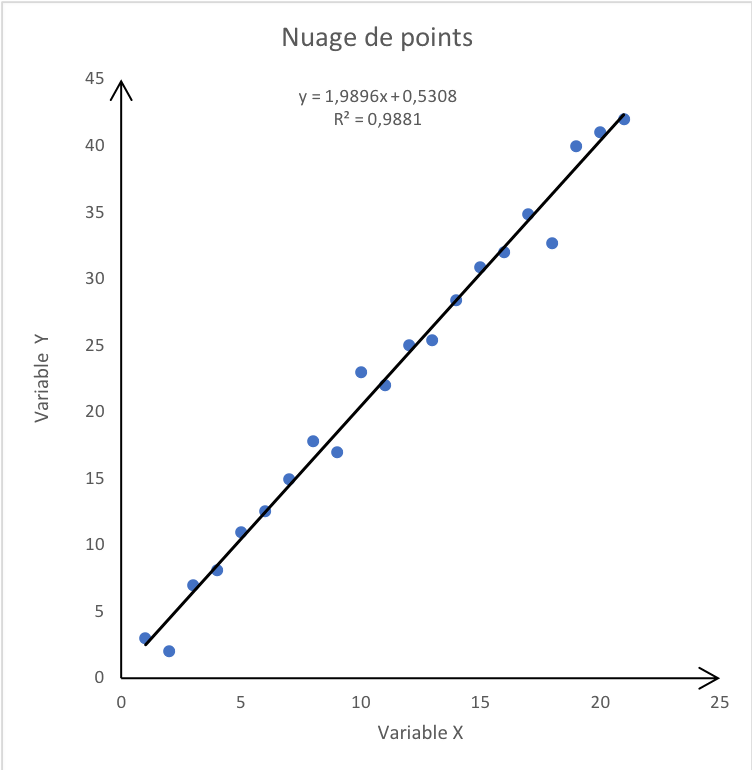
Example: In the calculation of the evolution of a population as a function of time the variable X is the time and the variable Y is the population.